
Financing Catalonia: an ongoing, crushing déjà vu
It hardly matters when you look at Catalan politics: you are always struck by the same sense of déjà vu, like waves breaking on a beach. They may arrive with more or less force, but they always return. The same debates. The same disappointments when dealing with the Spanish state. Facts repeatedly cut short by the same structural problem: Catalonia is not an independent state.
On 16 January 1641, the President of the Generalitat of Catalonia, Pau Claris (1586–1641), proclaimed the Catalan Republic in order to defend Catalonia’s political independence and freedom against attempts by the Spanish Crown to suppress the sovereignty of its internal kingdoms, including the Kingdom of Portugal. This is not so different from what we are witnessing today, half a millennium later, in 2026.
Catalans have begun the year with a perennial hot topic: the financing agreement for Catalonia. This is an agreement negotiated by Catalan parties with the Spanish government which must then pass through the approval of the entire Spanish Congress. This centralist procedure means that, more than an agreement, it should really be called a “proposal”. But that would expose the crushing and dramatic autonomic subordination under which we live. How much time and how many resources are wasted on this normalised political filibustering? It is insulting.
This so-called agreement on Catalan financing, negotiated by ERC with PSOE, made it possible for Salvador Illa (PSOE’s candidate in Catalonia) to be proclaimed President of the Generalitat de Catalunya in 2024. Similarly, it was thanks to the investiture agreements between Junts and ERC with PSOE that Pedro Sánchez (PSOE’s candidate in Spain) was proclaimed President of the Spanish state. Both Catalan “independentist” parties, ERC and Junts, justified these decisions by claiming they would lead to official status for the Catalan language in Europe and to unique funding arrangements for Catalonia, among many other promises.
Yet when it comes to putting things down in black and white, we are once again left with only the skeleton of the sardine. When the “what could have been” is crushed by the Spanish political reality, all that remains is history repeating itself, and too many Catalan politicians who refuse to learn its lessons.
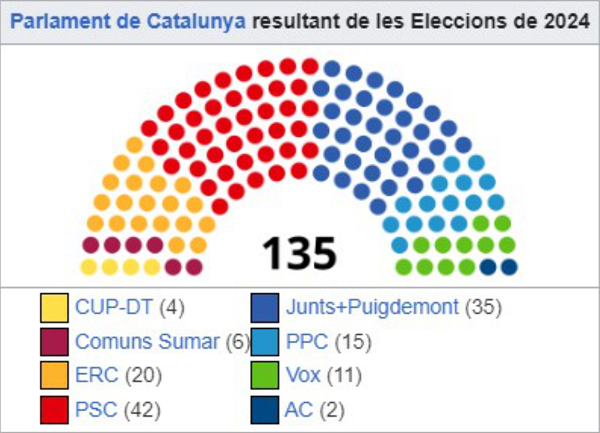
As shown in the graphic, Junts and ERC had enough votes to attempt a joint candidacy to win the Catalan Government. They could have responded to the message sent by independentist abstention, which prevented them from achieving a clear victory. A strong response, overcoming internal tensions and signalling “we hear you, let’s move forward”, could have reignited the spark. They were simply not interested. Nor are they interested in changing course today, as they persist with the same leadership and the same political dynamics that brought us to this point.
*The saying in Catalonia “only the skeleton of the sardine” is also well suited to the politics of Wales and the rest of Britain. It means that a party or government announces policies or promises with so little substance that only the sardine’s skeleton is left, and of course a sardine’s skeleton is worthless.
2026: a homage to Catalan masters
Fortunately, 2026 will be rich in events, conferences, and tributes to great figures of Catalan culture: an oasis in which to take refuge from the “autonomic” misery we are forced to endure.
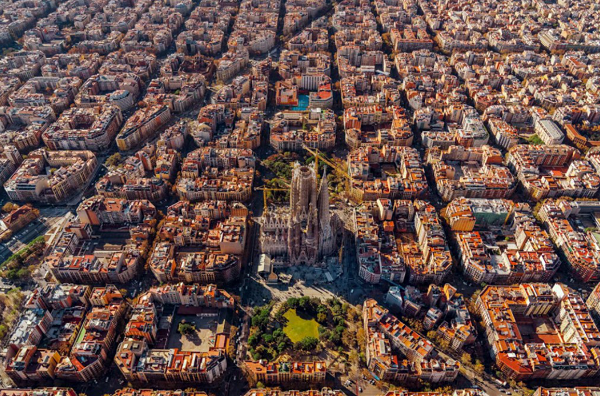
This year’s official commemorations will focus on many significant Catalan figures. To name just three: Idelfons Cerdà (1815–1876), engineer and urban planner, internationally recognised for Barcelona’s Eixample grid; Pau Casals (1876–1973), cellist and conductor, and author of the United Nations Hymn in 1971; and, of course, Antoni Gaudí (1852–1926), architect of the Sagrada Família and many other internationally acclaimed modernist buildings.
What many people may not know is that in September 1924, Gaudí, already immensely popular in Catalonia, suffered abuse and harassment at the hands of the Spanish police for refusing to abandon the Catalan language. He was arrested and taken to a jail cell for attending a mass held in tribute to those who fell in 1714. Yes, long before the Franco dictatorship, fascism was already being exercised against Catalans. Perhaps next time we will allow ourselves to delve more deeply into the lives and work of such remarkable figures.
To conclude, it is important to underline that many initiatives are currently being organised in Catalonia to confront this political dead end. As the Valencian intellectual Joan Fuster (1922–1972) famously said: “All the politics we do not make will be made against us.” We have had more than enough of that.
#YESCatalonia
Anna Arqué i Solsona - ICEC Catalan Countries