Much More than a Football Match
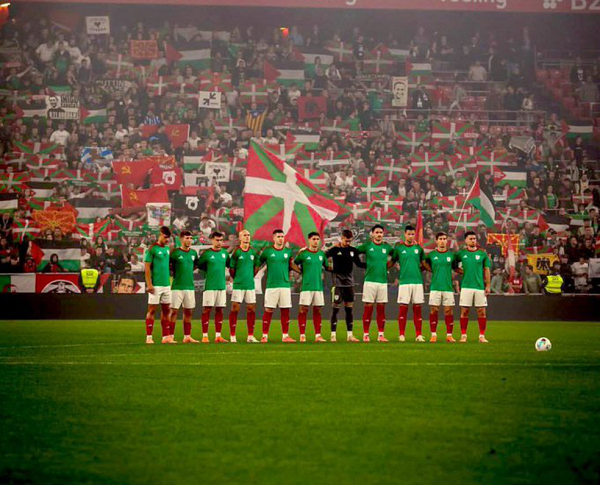
On 15 November 2025, San Mamés Stadium in Bilbao (Basque Country) was filled to capacity, with 51,000 supporters attending the football match between the Basque and Palestinian national teams.
This was far more than a sporting event. It was a powerful political statement with two clear demands: first, the official recognition of the Basque national football team and, secondly, an expression of solidarity with the Palestinian people who are currently suffering a brutal genocide.
The Basque national football team was founded in 1930 and will soon celebrate its 100th anniversary. It was banned during Generalissimo Franco’s dictatorship, although it continued to play matches in exile. After the dictator’s death, the team resumed its activity. Footballers from across the entire Basque Country represent the team, regardless of administrative borders.
Unlike other national teams from stateless nations—such as Scotland, Wales, or the Faroe Islands—the Basque national team is only permitted to play friendly matches, not official competitions. The reason is straightforward: the Spanish state prevents international federations such as FIFA and UEFA from granting the Basque Country (Euskal Herria) the right to field an officially recognised national team.
Opinion polls consistently show overwhelming support among the Basque population for the official recognition of Basque sports teams.
The Basque team won the match against Palestine 3–0. Yet, beyond the final score, the packed stadium sent an unmistakable message: the demand for a fully official Basque national team and the call to end the genocide against the Palestinian people were loudly and clearly expressed.
MASSIVE PROTEST AGAINST ATTACKS ON THE BASQUE LANGUAGE
On 7 January, Euskalgintzaren Kontseilua, the leading civil organisation working to promote and defend the Basque language, brought together thousands of people at a major demonstration in Bilbao.
The mobilisation aimed to denounce the growing attacks on the Basque language in recent years by the Spanish judiciary and to encourage Basque speakers to organise collectively in defence of their linguistic rights.
Although Basque is an official language in the Basque Autonomous Community (Western Basque Country), numerous court rulings have significantly undermined this status. Some judgments have even declared it illegal to require knowledge of Basque as a condition for employment in the public sector. In practice, this means that Spanish functions as the only fully official language while Basque is relegated to a second-class status.
In response, the Parliament of the Western Basque Country is currently considering the drafting of a new law aimed at preventing such legal abuses. These rulings have been actively promoted by Spanish organisations and trade unions that oppose language normalisation.
Josu Albero - ICEC Basque Country